

Complete-Skin-Specialists
Our Services

Our dedicated
skin cancer clinic
in Sunbury

Our skin cancer practice operates from a dedicated facility at Building 2, Sunbury, staffed by doctors with advanced training in skin cancer detection and management.

time

Integrated internal pathways to our dermatologists, plastic surgeon and cosmetic dermal therapists.

experience

Book directly - no referral needed.

dermatologists

On-site biopsies, surgical excisions and cryotherapy.
Comprehensive skin cancer checks and treatment

Our established skin cancer clinic is located at 35 Station Street, Sunbury, positioned between our cosmetic and dermatology buildings.

Every appointment is conducted by a doctor who has completed advanced training specifically in skin cancer dermoscopy.

With complex cases requiring dermatological or surgical input, we refer internally to our team of Consultant Dermatologists or to Dr Kim Hughes, our Specialist Plastic & Reconstructive Surgeon (MED0001675707).

Comprehensive care

Our skin cancer practice is structured around a full clinical pathway from initial full-body examination through to diagnosis, treatment, and ongoing surveillance.

Where a lesion requires further investigation, we have the diagnostic tools and procedural capability to act on it in-clinic. Where a case requires dermatological or surgical input, we refer internally to our Consultant Dermatologists or Plastic Surgeon – no external referral, no starting over.

Every service below is part of that continuum.

Full-body skin check

A structured, methodical examination of all skin surfaces conducted by a skin cancer doctor. Your doctor will document lesions of interest, assess clinical risk factors, and advise on an appropriate review interval.

Dermoscopy

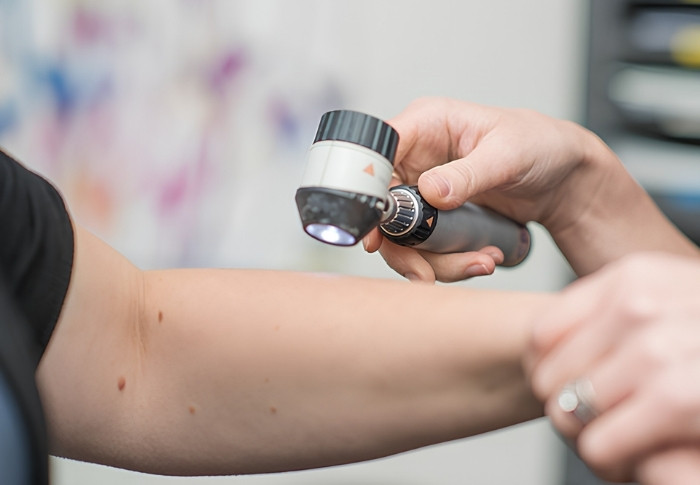
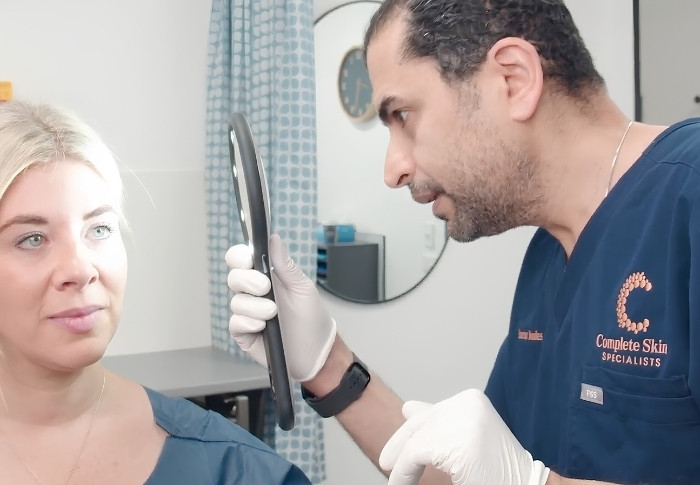
Your doctor will examine any suspicious lesions closely using a dermoscope, a handheld device with powerful magnification and a bright light.

This non-invasive technique enables us to examine pigmented skin lesions and distinguish lesions that require further investigation from those that do not.

Biopsy

If a lesion raises clinical concern, we may recommend a biopsy, a minor procedure to remove a tissue sample for laboratory analysis. The results tell us whether skin cancer has been found and, from there, we can recommend the most appropriate treatment pathway.

Surgical excision

Excision refers to cutting out the cancerous tissue along with a margin of healthy skin surrounding it. This is the standard treatment for confirmed skin cancers, including BCC, SCC, and early-stage melanoma.

Our doctors can perform these procedures in our clinic. If a lesion is in a visible area like the face, and there are concerns about scarring, we may refer to our Specialist Plastic Surgeon, Dr Kim Hughes (MED0001675707).

Cryotherapy

Cryotherapy uses liquid nitrogen to freeze and destroy targeted tissue. It is a minimally invasive treatment that may be used for benign surface lesions, and, in some cases, small superficial cancers.

Mole removal

Medical and cosmetic mole removal are distinct procedures with different clinical indications and fee structures. Your doctor will clarify which applies at your appointment.

Medical mole removal is performed when clinically necessary. A Medicare rebate may be available for this service (if you hold a valid Medicare card).

Cosmetic mole removal may be performed for benign lesions that are physically irritating or cosmetically bothersome. This is an elective procedure and is not covered by Medicare and may be internally referred to Dr Cara McDonald.

Complex cases

If your case requires dermatological or surgical input beyond the scope of the skin cancer practice, we may refer you to:

• Our Consultant Dermatologists for medical management
Dr Kim Hughes (MED0001675707), Specialist Plastic Surgeon, for reconstructive procedures following excision
• Another suitably qualified plastic surgeon depending on your needs, availability and preferred provider.

This keeps the care pathway intact and avoids the friction of an external referral.

Education and risk counselling

Your consultation includes a discussion of your personal skin cancer risk profile based on your lifestyle, UV exposure history, skin type, and family history. You’ll also receive guidance on sun protection and screening frequency.

Our skin cancer doctors

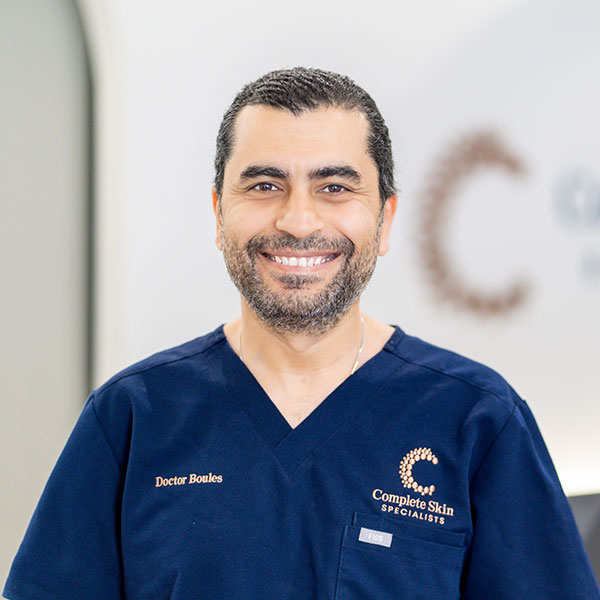
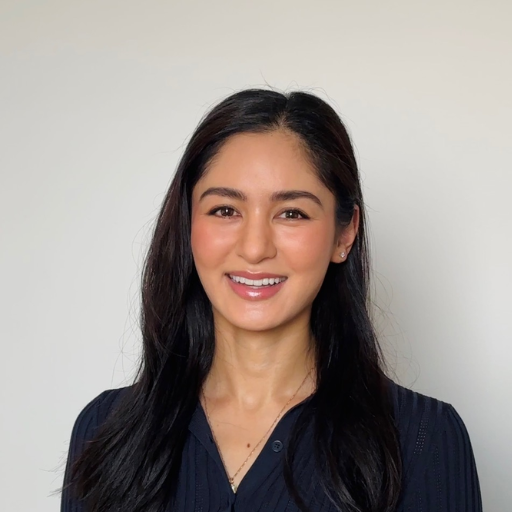
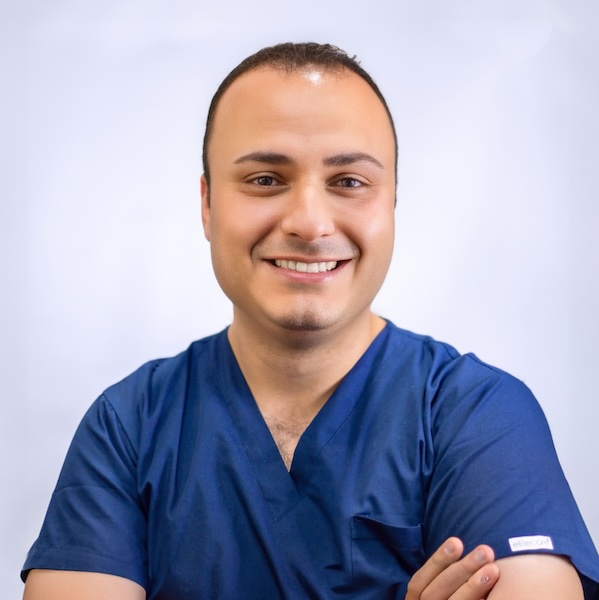
Our skin cancer doctors have completed advanced training in skin cancer. They each have considerable clinical experience across detection, diagnosis, and management.

Skin Cancer Doctor
Skin Cancer Doctor
Skin Cancer Doctor
Skin Cancer Doctor

Our skin cancer doctors

Our skin cancer doctors have completed advanced training in skin cancer. They each have considerable clinical experience across detection, diagnosis, and management.

Fees and Medicare rebates

We believe in full transparency about the costs of your care so you can make a fully informed decision.

Consultation fees

ServiceMedicare item no.Fee payable on the dayMedicare rebateOut-of-pocket
Skin check < 20 mins23$170.00$45.05$124.95
Skin check > 20 mins36$200.00$87.10$112.90

Procedure fees

ServiceMedicare item no.Fee payable on the dayMedicare rebateOut-of-pocket
Skin biopsy (1)30071$101.85$53.20$48.65
Skin biopsy (2)30071$152.80$79.80$73.00
Skin biopsy (3-4)30071$240.80 – $253.80$93.10 – $106.40$147.70
Skin biopsy (5+)30071$296.80 +$119.20$177.60
Skin biopsy (Returning 2+)30071$253.70 +$79.80$173.90
Cryotherapy > 10 lesions30192$71.10$40.25$30.85
Intralesional steroid30207$77.00$45.35$31.65
Drainage abscess30219$56.90$27.85$29.05
Curettage and diathermy30196$172.25$128.45$43.80
Cryotherapy (repeat freeze-thaw cycles)30202$77.00$49.15$27.85
Procedure feeTBA TBA$250 – $500

Non-Medicare service fees

Lost script fee (replacement script)$25

Terms and conditions

  • Medicare rebates are only available to patients holding a current Medicare card.
  • Fees and Medicare rebates are subject to change without notice.
  • 30202 and 30196 must have proven histopathology before being able to charge.
  • Procedures such as biopsies or cryotherapy will be subject to the multiple procedures rule. This means that the second procedure will be charged at 50%, and subsequent procedures will be charged at 25%.
  • Surgical Excisions depending on complexity and number of lesions estimated: $250 - $500 out of pocket.

What to expect

At Complete Skin Specialists, we offer a structured and supportive process to assess your skin health and assist with early detection and treatment of skin cancer where needed.

Attend a consultation

Attend a consultation

Meet with one of our Skin Cancer Doctors for a comprehensive full body skin check.

time

Tell us your concerns

For example, you may be seeking help to:

  • Check a changing mole or spot
  • Have a routine skin cancer check
  • Discuss your personal or family skin cancer risk.

experience

Receive a treatment plan

Your doctor will explain any findings and, if required, discuss options such as monitoring, biopsy, or removal. This includes outlining any procedures, costs, and follow-up.

Commence treatment

Commence treatment

Minor procedures such as biopsies or excisions may be performed in-clinic where clinically appropriate. If further treatment or referral is required, your doctor will guide you through the process.
What is skin cancer?

Skin cancer develops when UV radiation damages skin cells, causing them to replicate uncontrollably. Australia’s UV levels and outdoor culture contribute to some of the highest skin cancer rates in the world.

There are three primary types of skin cancer:

  • Basal cell carcinoma (BCC): The most common form. BCCs typically present as a translucent or pearly lump, a pink scaly patch, or a sore that doesn’t fully heal. Slow-growing and rarely life-threatening, but capable of causing significant local tissue damage if untreated.
  • Squamous cell carcinoma (SCC): Often presents as a red, thickened, or crusted lesion on sun-exposed skin. SCCs carry a higher risk of spreading than BCCs and warrant prompt assessment and treatment.
  • Melanoma: The most dangerous type, typically identified as an irregular, changing mole or pigmented lesion.
What is skin cancer

When to seek assessment

Any lesion that is new, changing, bleeding, itching, or simply different from surrounding skin warrants a clinical review.

Annual full-body skin checks are recommended for all adults – and more frequently for those with fair skin, a history of significant UV exposure, or a personal or family history of skin cancer.

Book a skin check at our Sunbury clinic

Skin cancer is highly treatable when caught early. Our skin cancer clinic offers doctor-led assessments, on-site procedures, and direct pathways to comprehensive care.

You don’t need a referral. You just need to book.

Frequently asked questions

No. Our skin cancer clinic accepts direct bookings from new patients. Here’s how to make an appointment.

Skin check appointments are typically 20–30 minutes. If a procedure is required on the day, additional time will be needed.

Annual skin checks are recommended for all adults. More frequent review may be recommended if you’re at higher risk due to:

  • Fair skin
  • A history of significant UV exposure
  • A personal or family history of skin cancer.

Your doctor will explain the finding and recommend a next step, such as monitoring, biopsy, or excision. Procedures can often be performed in-clinic, either at the same appointment or a scheduled follow-up.

Our skin cancer doctors are GPs who have completed advanced training specifically in skin cancer medicine. The clinic is equipped for in-house diagnostics and procedures, and has direct referral pathways to our Consultant Dermatologists and Plastic Surgeon for cases that require professional input.

In some cases, yes. This depends on the clinical findings, the nature of the lesion, and the procedure required. Your doctor will advise you at your appointment.

Our skin cancer practice is at Building 2, 35 Station Street, Sunbury VIC 3429. It operates as a dedicated facility, separate from our cosmetic and dermatology practices.