

Complete-Skin-Specialists
Complete Skin Specialists

Laser tattoo removal in Sunbury

When a tattoo no longer suits your life, your look, or your livelihood, laser tattoo removal offers a way to fade or clear unwanted ink under professional care.

Complete Skin Specialists’ Cosmetic and Laser Clinic offers tattoo removal in Sunbury using the Q-Switch laser.

Laser-Tattoo-Removal
Complete Skin Specialists
How laser tattoo removal works​

How laser tattoo removal works

Tattoo ink stays visible on your skin because it is composed of large molecules that your body cannot break down.

That’s great when you love your tattoo. But if you’re ready to get rid of it, then a tattoo removal laser can help your body clear the ink.

Here’s how laser tattoo removal works:

The laser settings are adjusted to match your tattoo’s colour palette

Different ink colours absorb different wavelengths of light.

The laser hits the ink

The laser sends short pulses of high-intensity light through the top layer of skin to strike the ink particles beneath it.

The ink breaks apart

The ink particles absorb the laser's energy and fragment into much smaller pieces.

The body clears the ink away

Over the following weeks, your immune system gradually removes these smaller fragments, and the tattoo fades a little more with each treatment.

Factors that influence your results

Several factors affect how a tattoo responds to laser removal:

Ink colour

Black and dark blue inks typically respond well; greens, yellows and light colours can be more resistant to treatment.

Tattoo age

Older tattoos have often already faded somewhat and may respond differently to newer ink.

Location on the body

Areas with better circulation, such as the chest and face, tend to clear ink more efficiently than areas like the feet and hands.

Skin type

Skin tone and sensitivity influence which laser settings are appropriate and how the skin heals between sessions.
Introducing the Q-Switch Laser

Q-Switch lasers release energy in nanosecond pulses – bursts so short and intense that the ink absorbs the energy faster than it can dissipate as heat. This means the ink particles fracture from the force of the pulse itself, rather than from heat spreading through the skin.

A tattoo with several ink colours may need more than one laser setting across its treatment plan because different colours absorb different wavelengths. We may use:

  • A 1064nm wavelength to target darker inks such as black and dark blue
  • A shorter 532nm wavelength to target warmer tones like red and orange.

At Complete Skin Specialists, Q-Switch laser technology sits alongside our broader range of laser treatments for pigmentation, vascular concerns and skin resurfacing.

Tattoo removal at Complete Skin Specialists

From your first consultation through to your final session, here's what treatment at Complete Skin Specialists involves.

Consultation

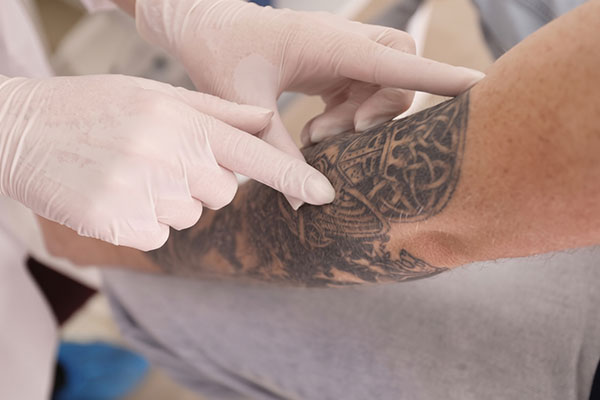
Before starting any treatment, we conduct a comprehensive consultation. During this appointment, your clinician may:

This information enables your clinician to determine whether laser removal is suitable and what results might realistically be achieved.

Consultation

Treatment plan

Following your consultation, your clinician puts together a treatment plan tailored to your tattoo.

This covers:

Because every tattoo is different, this plan is specific to you rather than a standard package applied across all patients. Your clinician will talk you through it in detail so you know what treatment involves before you begin.

Some tattoos respond better to laser treatment than others. Professional tattoos with dense, saturated ink can take longer to clear than amateur tattoos with lighter ink. Your clinician will talk you through what to expect for your specific tattoo.

Treatment stages

Sessions are spaced several weeks apart to reduce the risk of skin irritation and give your body time to clear the treated ink. Your clinician checks your skin’s healing and your tattoo’s progress before each session, adjusting the plan if needed. This might mean changing laser settings, extending the gap between sessions, or reassessing how many sessions are required.

Early sessions

You’ll often notice the most visible change in the weeks following your early sessions because these target the most responsive ink.

Ongoing sessions

At this stage, treatment begins to focus on more stubborn ink, such as denser areas or more resistant colours. It’s common for fading to become more gradual at this stage.

Final sessions

Towards the end of a treatment course, sessions target any remaining faint ink. Some tattoos clear fully; others fade substantially without disappearing completely, depending on factors such as ink colour and depth.
Your clinician will discuss what's achievable for your specific tattoo throughout the process.

Tattoo removal aftercare

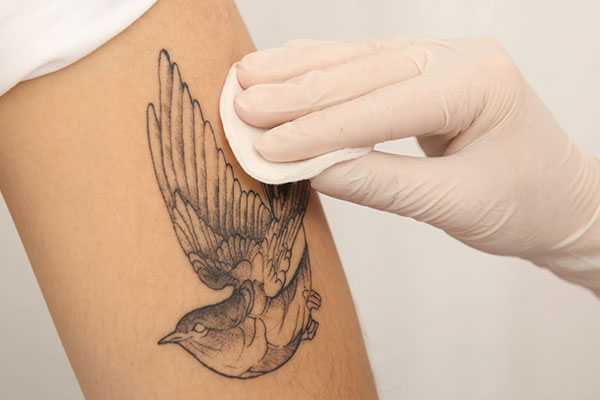
The treated area needs care between sessions to heal well and support the removal process. In some cases, the treated area may be red, tender or a little blistered, similar to a sunburn.
Tattoo removal aftercare includes:

  • Applying a cold compress to ease any initial discomfort
  • Keeping the area clean and dry
    Resisting the urge to pick at any scabs or blisters (this can affect healing and increase the risk of scarring or infection)
  • Avoiding sun exposure for 2 weeks. When you are outside, keep the treated area covered or, at the very least, apply SPF50+ sunscreen.
  • Avoid swimming, saunas, spa baths and strenuous exercise for at least a few days, as sweat, chlorine and friction can all irritate healing skin.

Please contact us if you notice signs of infection, such as increasing pain, spreading redness, warmth or discharge from the area.

Frequently asked questions

The laser breaks tattoo ink into smaller particles that the body’s immune system gradually clears over the weeks following treatment.

Laser tattoo removal is delivered as a course of treatments rather than a single visit because:

  1. Each session only breaks down a portion of the tattoo’s ink — a single pulse can’t fully fragment dense, saturated pigment in one pass
  2. The body needs time between sessions to clear away the fragmented ink before further treatment can effectively target what remains.

The number of sessions required depends on factors such as the tattoo’s size, ink density, colour palette and how long it’s been in your skin.

Sessions are typically spaced several weeks apart to allow the skin to heal and the ink-clearing process to complete before further treatment.

Redness, swelling and tenderness are common in the days following treatment, and the area may blister or scab as it heals. Following your clinician’s aftercare instructions supports recovery.

Ink colour, tattoo age, its location on the body, and your skin type can all influence how well a tattoo responds to treatment.

Like all medical procedures, laser tattoo removal carries risks, which we will discuss with you before treatment.

These include:

  • Redness, swelling, tenderness and blistering, which should usually settle within a few days or weeks
  • Temporary pigment changes that make treated skin lighter or darker than surrounding skin
  • Scarring and infection – closely following aftercare instructions helps reduce these risks.

Ready to tackle your tattoo?

If you’re considering laser tattoo removal, the first step is a consultation with our team.

We’ll assess your tattoo and skin, talk through what’s realistic for your situation, and build a treatment plan around your goals.

CSS employees

Book your appointment today - complete the request form.

Save 20% off skincare
Save 20% off skincare Mobile

For Limited Time Only

T&Cs apply. Offer valid on selected products only from 23 November to 4 December 2026. RATIONALE products excluded.